MEALS INCLUDED: BREAKFAST, LUNCH
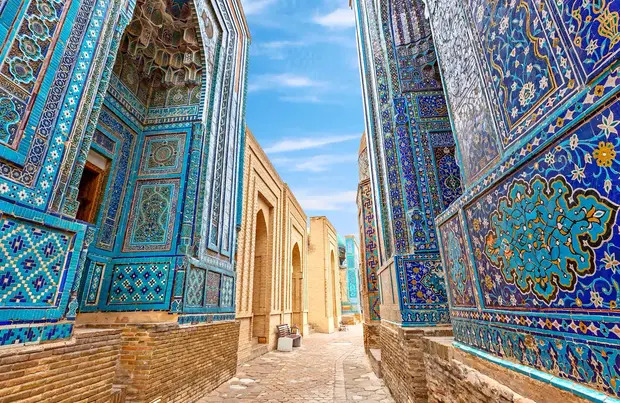
During the city tour in Bukhara, we will visit the Mausoleum of the Samanids (9th–10th centuries), built using proportional techniques. In the era of great mathematicians, the principles of geometry were applied to architecture.
Next, we visit the Bolo-Hauz Mosque (early 20th century) and the Ark Citadel (4th century B.C.), the oldest structure in the city. It served as the residence of the emirs of Bukhara, occupied from the 5th century until 1920, when it was bombarded by the Russian army. The last coronation held there was that of Ali Khan in 1910.
We also visit the Chashmai Ayub Mausoleum and Sacred Spring (14th century), also known as “the Spring of Job.” This is a sacred site believed to have been visited by the prophet Job. The waters are considered pure and are believed to have healing properties.
The Kalon Minaret, built in 1127, represents Bukhara’s history from the 11th–12th centuries. Its base is 9 meters in diameter, gradually tapering toward the crown, which is decorated with stalactite motifs, reaching a height of 46 meters.
The Poi Kalon Mosque (12th century) measures 127 × 78 meters and is one of the largest in Central Asia. The Miri Arab Madrasah, built during the reign of Khan Ybaidulli between 1530 and 1536, is also visited.
We will see three historic markets: this 16th-century domed complex, known as the First, Second, and Third Domes, consists of vaulted halls connected by numerous galleries used for trade and artisan workshops.
Finally, we visit the Lyabi Hauz Architectural Complex (14th–17th centuries), a group of two madrasahs and a khanaka built around the city’s largest pond.
At the end of the tour, we return to the hotel.